Pangnostics
Products
Pangnostics dFC ZetaView® Evolution ZetaView® x30 Lyophilized Exosomes F-NTA Antibodies
Explore
Applications Services Contact Request a demo
Accelerating the particle research of life

Count the particles other instruments can't see.

As the official channel partner for the field's most sensitive nanoparticle platforms, Bioparticle brings the instruments and reagents that resolve the size, charge, and surface markers of biological nanoparticles — down to a single molecule, with no calibration curves and no compromises — to your lab.

lipid bilayer · ≈5 nm
Fig. 01 — Extracellular vesicle · tetraspanin surface markersCD9 · CD63 · CD81
Particle-Metrix Logo
Particle Metrix
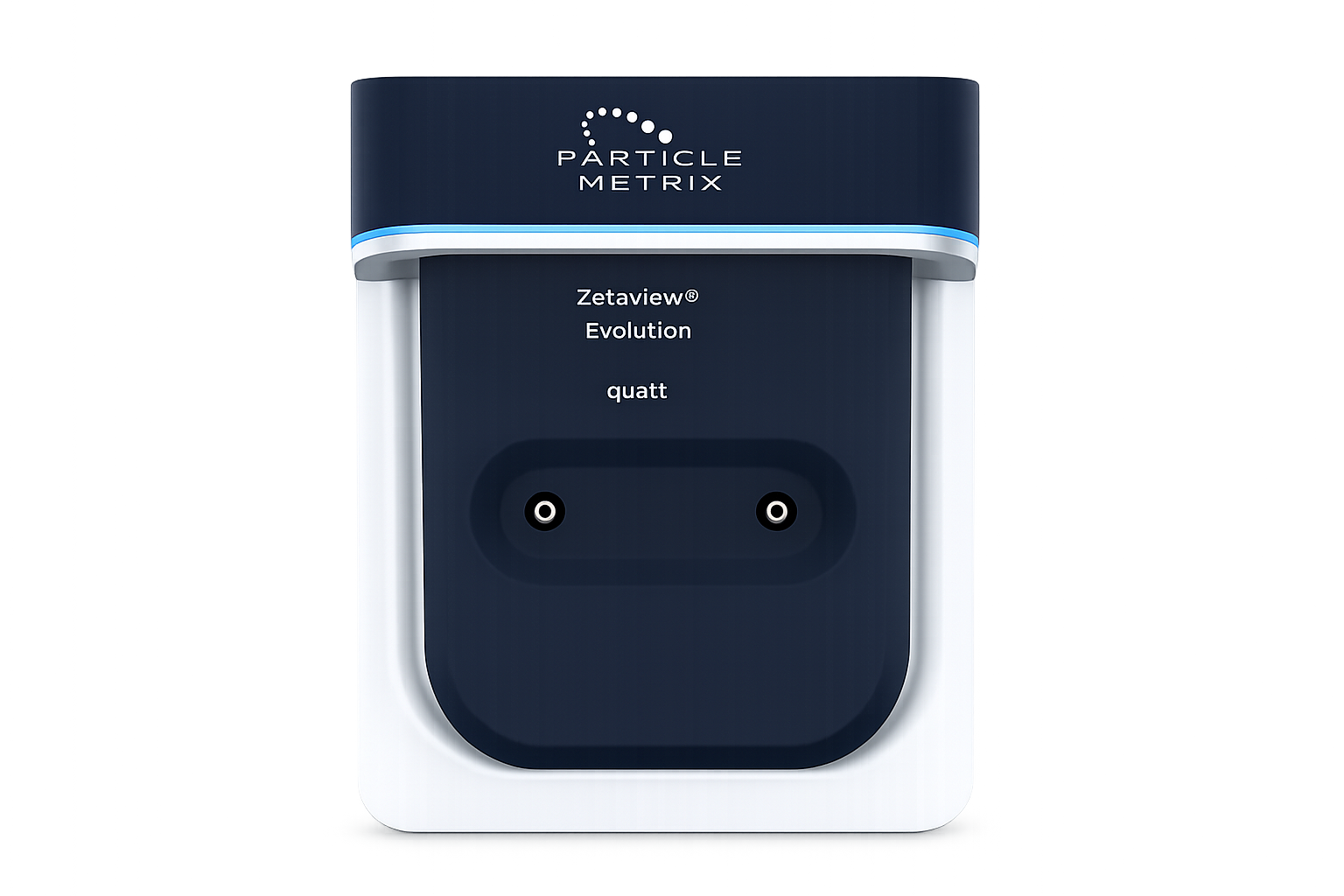
Particle Metrix · ZetaView

Next-Generation Particle Characterization Platform

Partical Matrix ZetaView evaluation platform integrates cutting-edge detection modules for complete biological particle analysis. Designed for reliability, reproducibility, and simplicity, it eliminates manual calibration and provides real-time quantitative data.

Measure size concentration, zeta potential, and fluorescence simultaneously. Adaptive sample scanning for unknown particle compositions. High-sensitivity optics with automated parameter control. Data you can trust — every scan, every sample.
Pangnostics Logo
Pangnostics
Pangnostics · digital flow cytometry

Next-Generation Digital Flow Cytometry Platform

Pangnostics delivers a breakthrough in particle analysis with its Digital Flow Cytometry platform-bringing single-molecule precision to complex biological systems. By overcoming the detection limits of conventional cytometry, it enables researchers to uncover hidden subpopulations and generate truly quantitative insights.

Ultra-sensitive detection down to single molecules. Expose hidden nanoparticle populations beyond traditional limits. High-dimensional phenotyping with expandable multi-color architecture. Direct digital counting — no calibration curves, no compromises.
Inside the instruments

Two ways of seeing the nanoscale.

These platforms read biological particles through complementary physics — tracking how particles move, and counting the single molecules on their surface.

Particle Metrix · ZetaView

Nanoparticle Tracking Analysis

A laser illuminates particles suspended in the cell; a camera records each one scattering light and dancing under Brownian motion. The Stokes–Einstein relation turns that motion into a hydrodynamic size and an absolute count — particle by particle, no calibration curve required.

Tracking → size & concentration Electrophoresis → zeta potential F-NTA → fluorescence
Pangnostics · digital flow cytometry

Single-Molecule Digital Counting

Sample flows through a planar microfluidic channel where line-confocal optics and four lasers interrogate a tiny detection volume. Each fluorophore-tagged molecule is counted as it passes — across twelve channels — giving absolute, calibration-free numbers and per-particle phenotypes that bulk methods average away.

Count → absolute concentration Colocalize → multiplex phenotype Copies/particle → surface density
How the methods compare

Most of the EV population hides below the floor.

Therapeutic and biofluid preparations are dominated by 30–70 nm vesicles. Where a method's detection floor sits decides whether you measure the real sample — or a brighter, biased subset of it.

Drag the detection floor — see the sample you'd actually measure

of EVs captured
apparent median size

Illustrative model of a real EV population, where the smallest vesicles dominate. Single-molecule detection reaches ≤35 nm; raising the floor toward conventional limits hides the majority and inflates the apparent size.

Method Smallest particle Label-free size Per-particle Absolute count Copies / particle
Western blot / ELISA bulk (no sizing)
Conventional flow ~500 nm relative
High-sensitivity flow ~70–80 nm bead-calibrated semi
Nanoparticle tracking (NTA) ~30 nm*
Single-molecule dFC ≤35 nm fluorescence ✓ calibration-free

* NTA sizes and counts label-free; single-molecule dFC adds fluorescence phenotyping and surface-marker copy number. Simplified for comparison — not a substitute for method validation.

The measurement evolution

From bulk averages to single molecules.

Each step in EV characterization recovered detail the previous one averaged away.

Stage 01

Bulk averaging

Western blot & ELISA confirm a marker is present — but only as a population average, blind to how it's distributed.

Stage 02

Particle tracking

NTA reads Brownian motion to give label-free size, concentration, and zeta — particle by particle.

Stage 03

Single-EV phenotyping

High-sensitivity flow resolves markers on individual vesicles — but a detection floor still hides the smallest EVs.

Stage 04 · now

Single-molecule digital

Pangnostics dFC counts individual molecules to ≤35 nm — absolute, calibration-free, with copies-per-particle.

Nanoparticles in biology

Small particles, outsized roles.

Extracellular vesicles ferry proteins and RNA between cells — making them biomarkers, drug-delivery vehicles, and therapeutics in their own right. The same analysis extends across the nanoscale of life.

Extracellular Vesicles

Size, concentration, and surface markers — with per-EV phenotyping.

Viruses & VLPs

Characterisation for diagnostics and vaccine development.

Nanobubbles

Size, charge, and stability across diverse media.

Lipid Nanoparticles

LNP analysis for drug delivery and mRNA therapeutics.

Environmental

Tracking nanoparticles for ecological impact studies.

The portfolio

Instruments and reagents, end to end.

Let's map the right measurement to your biology.

Start a conversation

For Research Use Only. Not for use in diagnostic procedures.